 TopoTopo
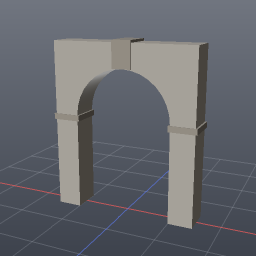
topotopo/architecture/arch
Stone arch: a wall block with a round, pointed (equilateral gothic) or flat-topped opening cut by a 2D boolean and extruded, with impost blocks at the spring line and a keystone.
37 ready-made generators in 4 packages, TopoTopo's own packages: walls, windows and doors, whole
houses, roofs, stairs, railings and floors, props, trees and rocks, roads and street furniture, and generators that dress
a road or a terrain. TopoTopo carries them built in (library/), so they work
offline and every package finds them without listing a library. A package's graph names an output by its full name; the
first use copies the package's version into the package and locks it, as for any package, and a newer version a TopoTopo
release brings shows as an update. Each output documents its typed parameters, puts its pivot at the base and tags every
piece with name and material; it says what it is (its kind) and carries tags a search finds it by
(topotopo search --tag street-furniture, or the MCP workspace tool's search action, across
every library). Parameters, inputs and examples are in the
node reference.
{ "nodes": { "stairs": { "type": "topotopo/architecture/stairs", "params": { "steps": 16, "style": "open" } } } }walls with windows and doors, houses on any footprint, gable, hip and straight-skeleton roofs, stairs and spiral stairs, railings, pillars and arches, brick walls, tiled and hexagonal floors, trusses and scaffolds. Its default output, topotopo/architecture alone, lines them up.
Stone arch: a wall block with a round, pointed (equilateral gothic) or flat-topped opening cut by a 2D boolean and extruded, with impost blocks at the spring line and a keystone.
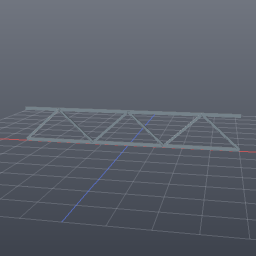
Planar truss in the XY plane: top and bottom chords, verticals and diagonals in Warren, Pratt or Howe layout, swept with a steel I-section or a square timber section.
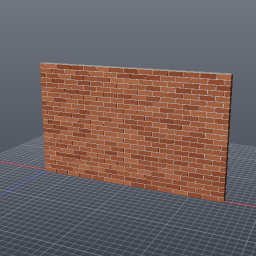
Brick wall from x = 0 to x = wall_length: individual bricks in running, stack, English or Flemish bond, cut to the wall ends and top, with random offset, yaw and tint, standing slightly proud of a recessed mortar core.
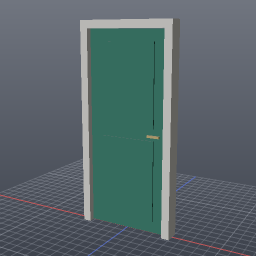
Door for a wall opening: jambs and head that fill the opening (width × height), a panelled leaf hinged on the left (-X) that swings towards -Z by open_angle, and lever handles on both sides.
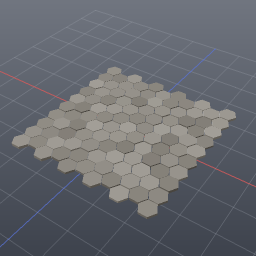
Hexagonal paving: flat-topped hexagonal prisms on a hex lattice filling a rectangle (tiles whose centre lies inside), with gaps and random height and tint.
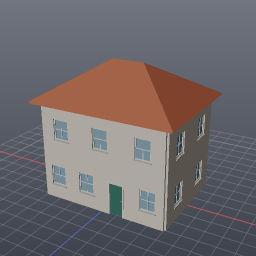
House built from a footprint polygon: one wall_segment per footprint edge (facing outward, floors stacked, a door on the first edge), topped with a roof_skeleton hip roof that follows the footprint exactly (straight skeleton: L-shapes, courtyards and any simple polygon get correct valleys and ridges).
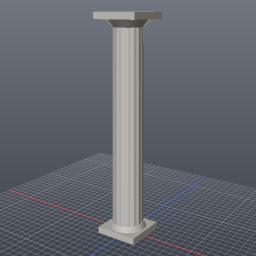
Classical pillar: a round, fluted or square shaft with an optional plinth base and capital.
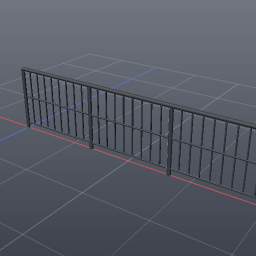
Railing along a curve (input 0; without one, a straight run of run_length along +X from the origin): posts at even spacing including both ends, a handrail on top, lower rails and balusters.
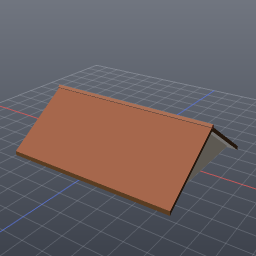
Gable roof for a width × depth footprint: two pitched slabs meeting at a ridge along X with a ridge cap, overhanging eaves and verges, and optional triangular gable walls under it.
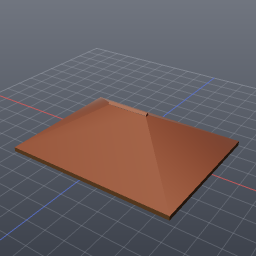
Hip roof for a width × depth footprint: four slopes at the same pitch meeting at a ridge along the longer side (a pyramid on a square), a fascia band and a flat soffit under overhanging eaves, and a ridge cap.
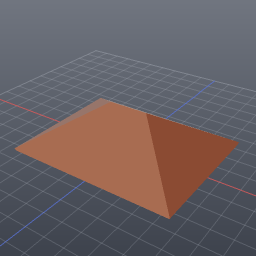
Straight-skeleton hip roof from an optional XZ footprint, including concave outlines and courtyard holes.
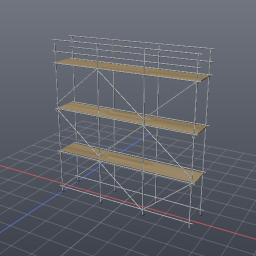
Tube-and-fitting scaffold: standards (verticals) on base plates, ledgers along X and transoms along Z at every lift, zig-zag face braces on the front (+Z), board decks on the lifts and guard rails at the top.
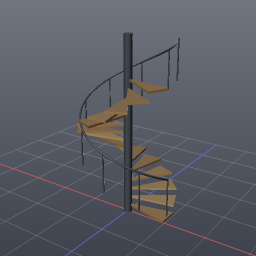
Spiral staircase: wedge treads turning counter-clockwise (seen from above) around a central column, with an optional helical handrail on posts.
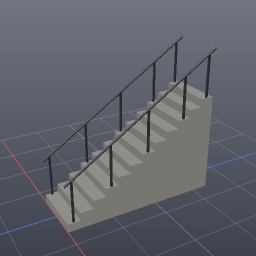
Straight stairs climbing along +Z: a solid concrete flight (one watertight sawtooth solid) or open wooden treads between two stringers, with optional handrails on both sides.
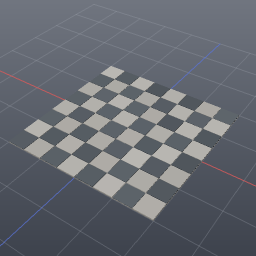
Tiled floor: square tiles in a grid, offset (half-tile) or checker pattern with grout gaps, random height and tint, cut to the floor edges, on a grout bed.
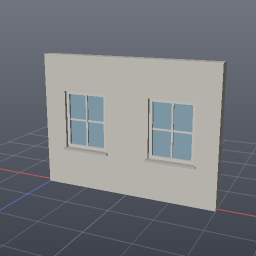
Straight wall from x = 0 to x = wall_length with window (and an optional door) openings cut by a boolean, filled with this package's window_frame and door_frame outputs.
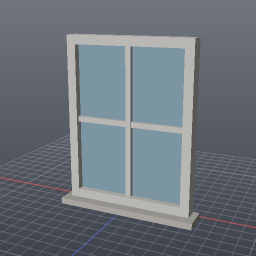
Window for a wall opening: a frame that fills the opening (width × height), mullions, a glass pane and a stone sill that sticks out at the front (+Z).
rocks and cliff blocks, low-poly trees, bushes and logs, and forests, grass clumps and scattered rocks that dress a surface. Its default output, topotopo/nature alone, lines them up.
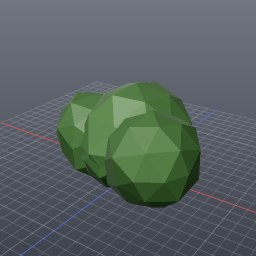
Low-poly bush: overlapping faceted blobs, cut flat at the ground.
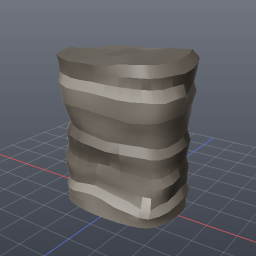
Cliff block: a tall rock mass with ridged noise, horizontal strata ledges and banded colour, flat on the ground.
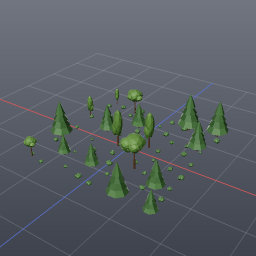
Forest on a surface (input 0; without one, a 30 × 30 m ground patch at y = 0): trees scattered by density with a minimum spacing on faces flatter than max_slope, kept upright with random yaw and height, as packed copies of three tree_lowpoly variants (conifer, round, poplar) picked by conifer_ratio, plus optional bushes between them.
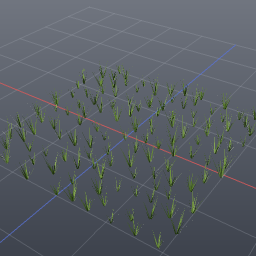
Grass clumps on a surface (input 0; without one, a 4 × 4 m ground patch at y = 0): each clump is a fan of thin two-sided blades leaning outwards; clumps are scattered by density on faces flatter than max_slope and copied as packed instances of two variants with random yaw and size.
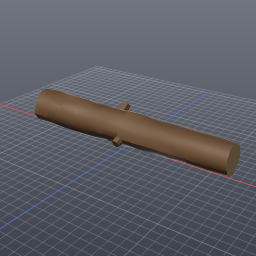
Felled log lying along X: a tapered trunk with ridged bark, light end grain and a few branch stubs.
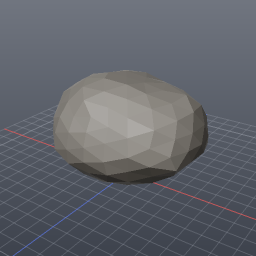
Low-poly rock: a noise-displaced icosphere, flattened, with faceted shading and a mottled tint.
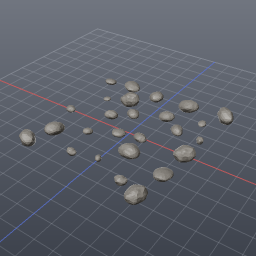
Rocks scattered on a surface (input 0; without one, an 8 × 8 m ground patch at y = 0): the slope mask keeps faces flatter than max_slope, scatter by density with a minimum spacing, rocks aligned to the surface with random yaw, tilt and scale, overlaps pruned, then packed copies of three rock variants (this package's rock output) sunk slightly into the ground.
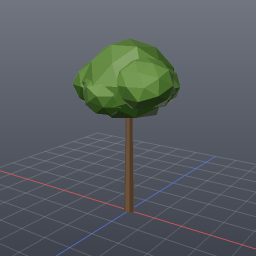
Low-poly tree in three styles: round (a cluster of faceted blobs), conifer (stacked cones) and poplar (a tall narrow crown).
barrels, crates, pallets, sandbag walls and pipe runs. Its default output, topotopo/props alone, lines them up.
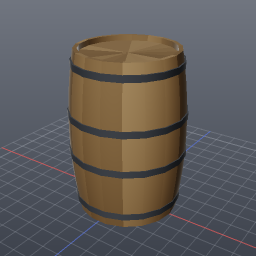
Wooden barrel: a bulged body of faceted staves with a recessed lid, and metal hoops.
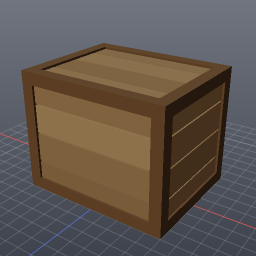
Wooden crate: plank walls with gaps on all six sides inside a frame of edge battens.
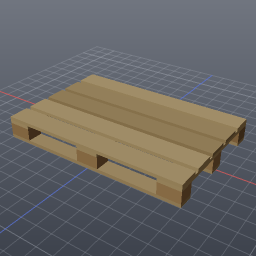
Block pallet (EUR style): bottom boards, a 3 × 3 grid of blocks, cross boards and a top deck.
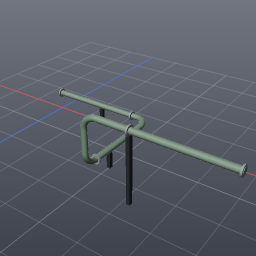
Pipe run along a polyline (input 0; without one, a default run that turns and rises): corners rounded into elbows of bend_radius, flanges at both ends and every flange_spacing metres, and floor stands under horizontal stretches.
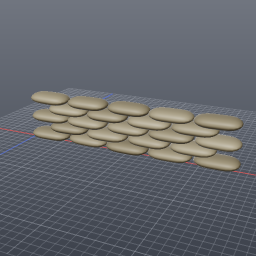
Sandbag wall from x = 0 to x = wall_length: rows of pillow-shaped bags in running bond, squashed onto each other, with random yaw, offset and tint.
roads with kerbs and sidewalks, lamp posts, bollards, benches, street signs, fences and hanging cables. Its default output, topotopo/street alone, lines them up.
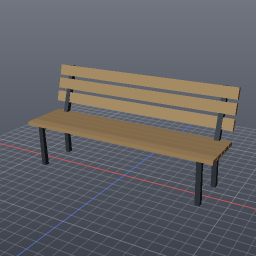
Park bench along X: wooden seat slats and an optional reclined backrest on cast-iron side frames (two, or three on long benches).
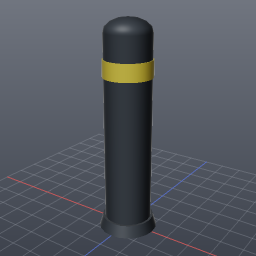
Street bollard: a round post with a domed top or a square post with a pyramid cap, an optional reflective band and a base ring.
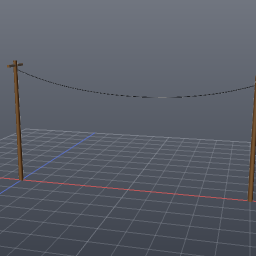
Hanging cable between two points: a catenary that sags by sag below the straight line at mid-span, swept as a tube, with optional wooden poles (with a cross arm and insulators) standing on y = 0 under the ends.
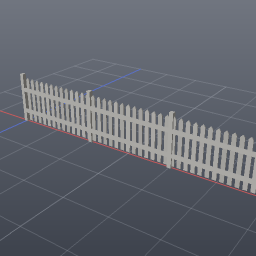
Fence along a curve (input 0; without one, a straight run of run_length along +X from the origin) in three styles: picket (white pointed pickets on two rails), plank (horizontal boards) and rail (three ranch rails).
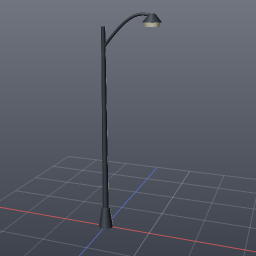
Street lamp: a tapered pole on a flared base with 1–4 curved arms carrying shades and glowing glass (arms 0 = a lantern on top of the pole).
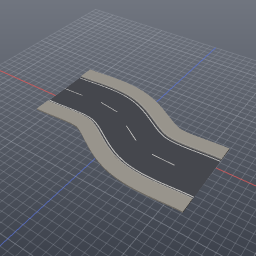
Road along a curve (input 0; without one, a gentle 24 m S-curve along X): an asphalt ribbon of width centred on the curve with solid white edge lines, dashed lane lines between lanes lanes, and kerbs with sidewalks on both sides.
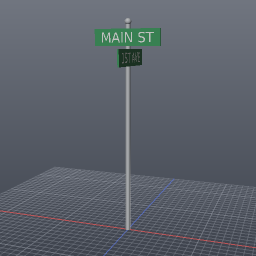
Street name sign: a post with a ball cap and a green blade (two crossed blades for a corner) carrying raised white lettering on both faces, scaled to fit.